
Things
Evolution
Evolution says every living thing descends, with modification, from common ancestors. Its mechanism, natural selection, was discovered twice in the 1850s — by Darwin after twenty years of caution, and by Wallace in a fever on a remote Indonesian island.
At a Glance
- Core claim
- Living things descend, with modification, from common ancestors over successive generations
- Key mechanism
- Natural selection — better-suited individuals survive and reproduce more
- Proposed independently by
- Charles Darwin and Alfred Russel Wallace
- Joint announcement
- Linnean Society, London, 1 July 1858
- Key publication
- Darwin's On the Origin of Species, 1859
- Completed by
- 20th-century genetics and, from the 1960s, molecular biology
- Deep ancestry
- All life derives from bacteria-like organisms of more than 3 billion years ago
Introduction
Evolution is the theory in biology that the various types of plants, animals and other living things on Earth descend from pre-existing types, their differences arising from modifications accumulated over successive generations. Britannica calls it one of the fundamental keystones of modern biological theory. All living creatures are related by descent from common ancestors: humans and other mammals descend from shrewlike creatures that lived more than 150 million years ago, and all plants and animals ultimately derive from bacteria-like micro-organisms that originated more than 3 billion years ago.
The theory needed a mechanism, and it got one twice. In the mid-19th century Charles Darwin and Alfred Russel Wallace, working independently on opposite sides of the world, both arrived at natural selection: individuals with more useful traits survive better and produce more offspring, so those traits spread. Darwin's evidence, gathered over decades, turned the idea into a system; 20th-century genetics then supplied the inheritance machinery Darwin lacked, and molecular biology filled in the details.
Background
Darwin had been developing his theory in private for some twenty years before he published anything, drawing on his voyage on HMS Beagle and on years of comparative study of living organisms, their geographical distribution and the fossil remains of extinct forms. Wallace came to the same answer by a collector's route: he travelled to the Amazon with Henry Walter Bates in 1848 to investigate the origin of species, financing the work by selling specimens, then spent eight years from 1854 in the Malay Archipelago, amassing some 125,660 specimens, including more than 5,000 species new to Western science.
In 1858, feverish and confined to his hut on the island of Ternate, Wallace had his realisation about how species change and wrote it up for Darwin, the one correspondent he knew was interested. Darwin, who had the same theory in manuscript, took advice from friends, and the two men's ideas were presented together at a meeting of the Linnean Society in London. Darwin's book followed the next year — and, as the Natural History Museum notes, Darwin has overshadowed Wallace ever since, though Wallace himself expressed no resentment and became Darwin's greatest supporter.
Timeline
- 1848
Alfred Russel Wallace and Henry Walter Bates reach the mouth of the Amazon in Brazil to investigate the origin of species, supporting themselves by selling specimens.
- 1854
Wallace begins eight years of collecting in the Malay Archipelago, where he will record some 125,660 specimens and notice the faunal boundary later called Wallace's Line.
- 1858
Confined by fever on Ternate, Wallace writes his essay on natural selection and sends it to Darwin, who has privately held the same theory for about twenty years.
- 1 July 1858
Papers by Darwin and Wallace are presented together at the Linnean Society in London, jointly announcing evolution by natural selection.
- 1859
Darwin publishes On the Origin of Species, the full statement of his theory, with its mass of supporting evidence from breeding, geography and fossils.
- 20th century
Genetics, a science born in the new century, reveals in detail how inheritance works and how natural selection operates, producing the modern theory of evolution.
- 1960s onwards
Molecular biology enormously advances knowledge of evolution, letting scientists compare DNA and proteins across species — the genes of humans and chimpanzees differ by only about 1–2 percent.
Significance
Evolution reorganised biology around a single explanation. The evidence Darwin and his contemporaries drew from comparative anatomy, geographical distribution and fossils has since been reinforced by every discipline that has touched the subject — genetics, biochemistry, physiology, ecology, animal behaviour and, above all, molecular biology. The information about evolutionary history stored in the DNA and proteins of living things is, as Britannica puts it, virtually unlimited, and the degree of similarity between molecules tracks the recency of common ancestry, so family trees of life can be reconstructed in detail.
Natural selection also explained design without a designer: features such as wings, eyes and kidneys, clearly structured for specific functions, arise because individuals bearing more useful variants leave more descendants. That single mechanism, operating over immense time, accounts both for adaptation and for the staggering diversity of life, from bacteria in near-boiling hot springs to fungi on Antarctic ice.
Legacy
The modern theory of evolution is Darwin and Wallace's mechanism completed by genetics: descent with modification, driven by selection acting on inherited variation, with mutation, migration and genetic drift also shaping populations. It underpins medicine, agriculture and conservation as well as pure biology, because pathogens, crops and endangered species all evolve in real time. Researchers no longer debate whether evolution occurred; they use its evidence to reconstruct exactly how life diversified.
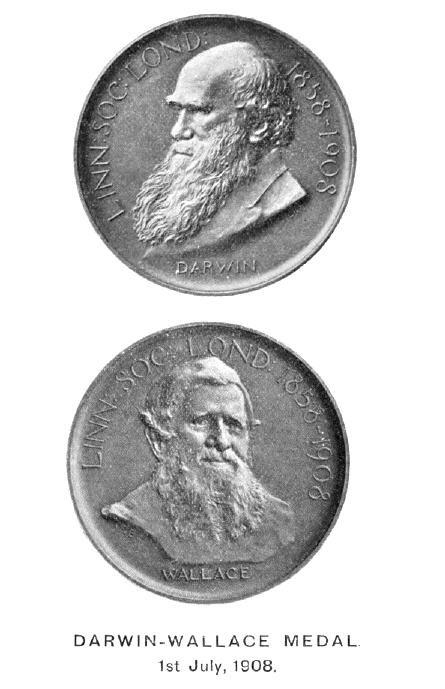
The Linnean Society marked the partnership in metal: the Darwin–Wallace medal, struck for the fiftieth anniversary in 1908 of the joint reading, carries both men's portraits. It is a fair emblem of the theory's origin — one idea, reached independently by a gentleman naturalist who waited twenty years and a professional collector who wrote his version in a fever, and strong enough to survive both of them.
Sources
- Natural History Museum, London — Who was Alfred Russel Wallace?
- Encyclopaedia Britannica — Evolution
- Science Learning Hub — Natural selection: Charles Darwin and Alfred Russel Wallace
- Wikipedia — Evolution
The facts on this page were checked against these sources on 19 November 2026. The History Trail's permanent pages are researched and written for this site; the live profiles elsewhere on The History Trail are assembled automatically from Wikipedia and Wikidata.
About the Author
Researched and written by the The History Trail Editorial Team — the accountable editorial function behind this site's permanent story pages. The team works from the published sources cited on each page; it does not invent historians, reviewers or credentials, and it corrects errors openly.
Fact Check
Every load-bearing fact on this page traces to one of the sources listed above, and significant claims link to their source in the text. Our checking method is described on the methodology page; errors can be reported via the corrections page.
Sources & Citations
Cite this page as: The History Trail Editorial Team, The History Trail — this article's title, publication and update dates are shown beneath its headline. The full source list appears under Sources above; the site's source standards are on the sources page.